

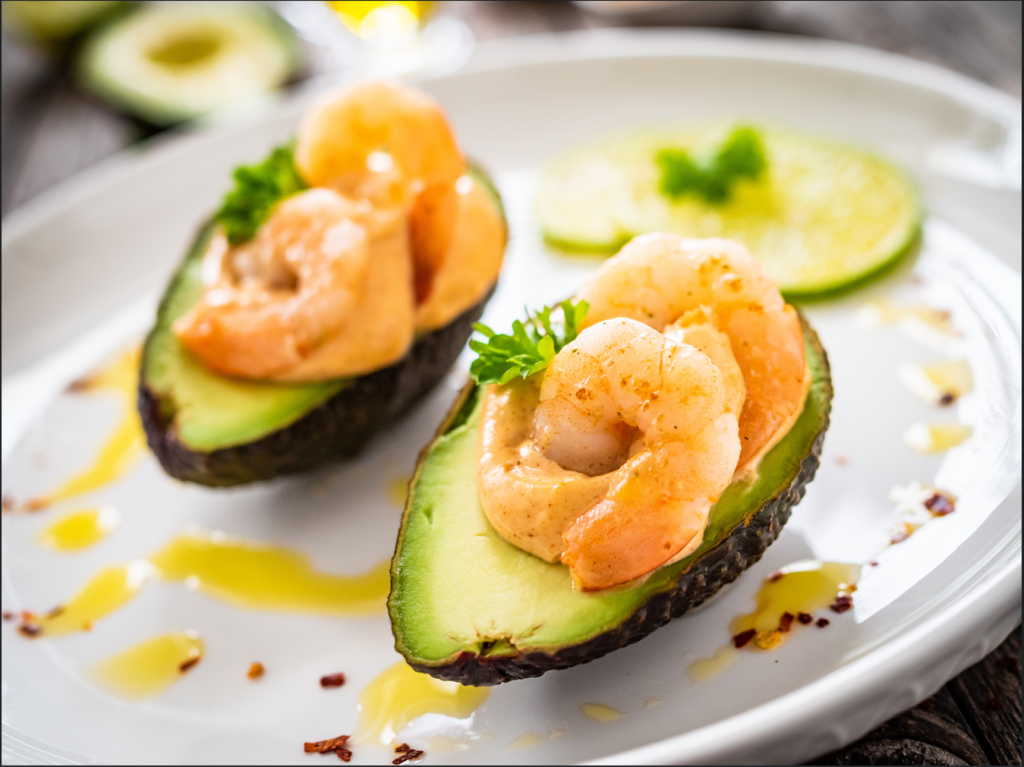
Remember prawn cocktail?
There was a time when prawns, half an avocado and Marie Rose sauce were the definition of dinner party sophistication.
Then someone shouted “cholesterol” and suddenly the poor prawn, the humble egg and all foods containing cholesterol were relegated to the “best not” list.
But here’s the thing: The cholesterol in food isn’t the same as the cholesterol in your blood.
Let’s bust a few of the cholesterol myths that we hear most often and look at what the evidence tells us about food, fat and cholesterol.
Myth 1: Cholesterol is bad for you
Fact: Your body needs cholesterol
Cholesterol is a waxy fat-like substance that is essential to life, used by your body to make hormones, vitamin D, bile acids and cell membranes.
Since cholesterol doesn’t mix well in blood, it needs to be transported by lipoproteins; imagine these lipoproteins are like taxis transporting cholesterol as passengers. You may have seen these before on your blood test as Low-Density Lipoproteins (LDL) and High-Density Lipoproteins (HDL).
HDL is involved in transporting cholesterol from tissues towards the liver while LDL carries cholesterol and fat to be used around the body. It is the difference in the size and number of LDL particles that can contribute to the build-up of fatty deposits in the artery walls as small or damaged LDL particles are likely to dump their load or get stuck in blood vessels.
It is this build-up, or plaque, that increases our risk of cardiovascular disease, as it narrows the blood vessels, making it harder for blood to flow. Parts of the plaque can also break off and cause a blockage. These plaques contain cholesterol, which is why it’s often blamed for causing cardiovascular disease. This doesn’t mean that cholesterol itself is the problem.
High cholesterol is flagged when measurements of these and other lipid types exceed the “healthy” range in a blood test, and doctors will also look at other health and lifestyle factors before making a diagnosis.
Your body makes most of its own cholesterol and does not absorb it well from food and if it does, it adjusts and makes less. In most cases you don’t need to eliminate foods containing cholesterol completely from your diet but instead think about the types of fat and the overall quality of your diet.
Myth 2: If a food contains cholesterol, I should avoid it
Fact: Dietary cholesterol and blood cholesterol aren’t the same thing.
Dietary cholesterol can affect blood cholesterol, but the size of the effect varies from person to person. For most people, saturated fat is an important dietary factor influencing LDL. This is why the overall composition of your diet matters more than the amount of cholesterol in an individual food.
Instead of asking “does this food contain cholesterol?”, think “what does the whole food and the whole meal look like?”
A prawn and avocado salad is a very different nutritional proposition than a highly processed ready meal or take away containing lots of saturated or trans fats.
Myth 3: If I eat well and exercise, I won’t have high cholesterol
Fact: Lifestyle is important but high cholesterol isn’t just a matter of how well you eat.
Blood cholesterol is influenced by a combination of factors that include genetics, hormones, age, medical conditions, medication and lifestyle choices such as smoking, exercise and diet. So, making a few changes to your lifestyle such as increasing exercise, smoking cessation and reducing alcohol may have a positive impact on your cardiovascular health.
Surprisingly, many women may see an increase during perimenopause and after menopause, as the protective effects of oestrogen wane.
Eating well and being active can support healthy cholesterol levels and cardiovascular health but having elevated cholesterol isn’t always about just ‘eating badly’.
If you already have heart disease, diabetes, or a family history of high cholesterol, you may have slightly different targets. Please speak to your GP if you are concerned about your blood test results.
Myth 4: If I cut all fat out of my diet, I’ll lower my cholesterol
Fact: It’s the type of fat you eat, and what you eat with it, that matters.
Fat and cholesterol, as we’ve explained above are essential to the body and so rather than aiming for a fat-free diet, aim for better balance.
We know that consuming an excessive amount of saturated and trans fats can raise the amount of LDL, the protein that transports cholesterol to the tissues, increasing the risk of cholesterol forming plaques in the arteries.
Replacing saturated fats with unsaturated fats such olive oil, nuts and oily fish, can help lower LDL. Fibre, especially soluble fibre such as that found in banana, avocado, beans, flaxseed, oats and barley, can help lower LDL by affecting the absorption and partly by prompting the liver to use cholesterol to produce bile acids.
Plant sterols and stanols can also reduce cholesterol absorption in the intestine. They occur naturally in small amounts in plant foods, while some specifically fortified foods contain higher amounts.
Making a few swaps, fatty processed meat for lean protein, reducing your intake of refined carbohydrates, adding seeds to your breakfast and an extra portion of vegetables to your dinner can support healthier blood cholesterol levels.
As with everything else we talk about on Re-Shape, the aim is for better balance when choosing which fats and foods to put on your plate.
Now remember that prawn cocktail perched elegantly on the top of half an avocado? You don’t need to wait for a 1990s dinner party revival to enjoy it.
It turns out that our dinner party hosts were on to a starter that’s a source of protein, vitamins, minerals and healthy fat and fibre.
So dig out those forgotten but oh so sophisticated avocado-shaped dishes and enjoy a retro dinner party classic!
Sources:
Carson JAS, Lichtenstein AH, Anderson CAM et al (2020). Dietary Cholesterol and Cardiovascular Risk: A Science Advisory From the American Heart Association. 141(3):e39-e53. doi: 10.1161/CIR.0000000000000743. Epub 2019 Dec 16. PMID: 31838890.
Ghavami A, Ziaei R, Talebi S, Barghchi H, et al (2023). Soluble Fiber Supplementation and Serum Lipid Profile: A Systematic Review and Dose-Response Meta-Analysis of Randomized Controlled Trials. Adv Nutr. 14(3):465-474. doi: 10.1016/j.advnut.2023.01.005. Epub 2023 Feb 2. PMID: 36796439; PMCID: PMC10201678.
Heart UK Guidance (2026). What is Familial hypercholesterolaemia (FH)? Online at https://www.heartuk.org.uk/fh/what-is-fh
Hooper L, Martin N, Jimoh OF et al (2020). Reduction in saturated fat intake for cardiovascular disease. Cochrane Database Syst Rev. 19;5(5):CD011737. doi: 10.1002/14651858.CD011737.pub2. Update in: Cochrane Database Syst Rev. 2020 Aug 21;8:CD011737. doi: 10.1002/14651858.CD011737.pub3. PMID: 32428300; PMCID: PMC7388853.
National Institute for Health & Care Excellence (NICE) (2023). Cardiovascular disease: risk assessment and reduction, including lipid modification. NICE guideline NG238. Online at https://www.nice.org.uk/guidance/ng238
NHS England (2023). Health Survey for England 2021 part 2: Adult’s health: Cholesterol. Online at https://digital.nhs.uk/data-and-information/publications/statistical/health-survey-for-england/2021-part-2/adult-health-cholesterol
NHS England AAC Clinical Subgroup (2024). Summary of National Guidance for Lipid Management for Primary and Secondary Prevention of CVD. Online at https://www.england.nhs.uk/aac/wp-content/uploads/sites/50/2020/04/lipid-management-pathway-version-7-March-2024.pdf
Schoeneck M, Iggman D (2020). The effects of foods on LDL cholesterol levels: A systematic review of the accumulated evidence from systematic reviews and meta-analyses of randomized controlled trials. Nutr Metab Cardiovasc Dis. 2021 May 6;31(5):1325-1338. doi: 10.1016/j.numecd.2020.12.032. Epub 2021 Jan 16. PMID: 33762150.
Wheatley S (2017). Cholesterol – The good, the bad and the ugly. Online at https://www.xperthealth.org.uk/x-pert-blogs/cholesterol-the-good-the-bad-and-the-ugly/